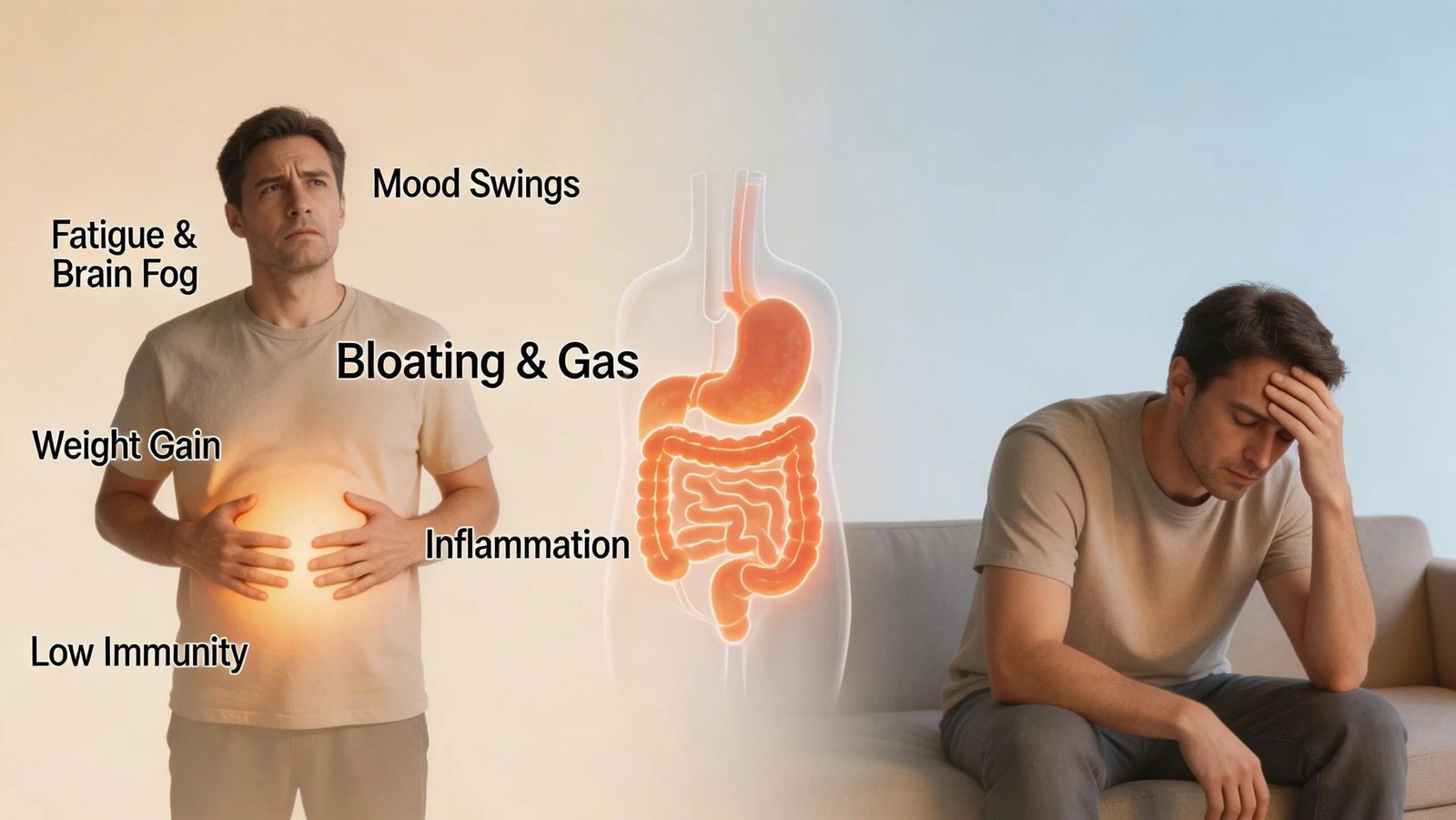
Gut health plays a vital role in how we feel every day, from energy levels to immunity. Gut health refers to the balance and function of the gastrointestinal microbiome, which plays a crucial role in digestion, immunity, metabolic regulation, and mental health. Yet many people struggle with digestive issues without knowing the root causes. Stress, poor diet, and lifestyle choices often disrupt the delicate balance of our gut. Let us explore the common culprits behind gut health problems and how they affect our overall well-being.
1. Poor Diet Choices
Diets high in ultra-processed foods, refined carbohydrates, and added sugars reduce microbial diversity and promote inflammation.
Example: Regular consumption of fast foods, sugary beverages, and low-fiber meals.
Evidence: Western diets are associated with reduced beneficial bacteria and increased gut permeability.1
2. Chronic Stress
Psychological stress alters gut motility, permeability, and microbial composition via the gut–brain axis.
Example: IBS flare-ups during exams or work stress.
Evidence: Stress-induced cortisol release affects gut barrier integrity and microbiota.2
3. Overuse of Antibiotics and Medications
Antibiotics reduce both pathogenic and beneficial bacteria, sometimes with long-term effects.
Example: Repeated antibiotic use for minor infections.
Evidence: Antibiotic exposure significantly reduces microbial diversity.3
4. Low Fiber and Fermented Food Intake
Dietary fiber acts as a prebiotic, while fermented foods provide probiotics.
Example: Diets lacking fruits, vegetables, legumes, and fermented foods.
Evidence: Fiber intake is positively correlated with microbial diversity.4
5. Poor Sleep Patterns
Circadian rhythm disruption alters gut microbial composition.
Example: Shift work or chronic late-night sleep.
Evidence: Sleep deprivation negatively impacts gut microbiota balance.5
6. Dehydration
Adequate hydration supports stool consistency and gut motility.
Example: Low water intake causing constipation.
Evidence: Hydration status affects bowel function.6
7. Sedentary Lifestyle
Physical activity increases microbial diversity and intestinal transit.
Example: Prolonged sitting with minimal exercise.
Evidence: Active individuals show greater gut microbial diversity.7
8. Ignoring Early Symptoms
Untreated minor symptoms may progress to chronic gut disorders.
Example: Persistent bloating or acidity treated symptomatically.
Evidence: Early dysbiosis can progress to chronic inflammation.8
References
- Zinöcker MK, Lindseth IA. The Western diet–microbiome-host interaction and its role in metabolic disease. BMJ Open. 2018;8(6):e019788. doi:10.1136/bmjopen-2017-019788.
- Mayer EA, Tillisch K, Gupta A. Gut/brain axis and the microbiota. Nat Rev Neurosci. 2015;16(11):673–685. doi:10.1038/nrn4013.
- Panda S, El Khader I, Casellas F, López Vivancos J, García Cors M, Santiago A, et al. Short-term effect of antibiotics on human gut microbiota. PLoS One. 2014;9(4):e95476. doi:10.1371/journal.pone.0095476.
- Makki K, Deehan EC, Walter J, Bäckhed F. The impact of dietary fiber on gut microbiota in host health and disease. Cell Host Microbe. 2018;23(6):705–715. doi:10.1016/j.chom.2018.05.012.
- Benedict C, Vogel H, Jonas W, Woting A, Blaut M, Schürmann A, et al. Gut microbiota and glucometabolic alterations in response to recurrent partial sleep deprivation in normal-weight young individuals. Mol Metab. 2016;5(12):1175–1186. doi:10.1016/j.molmet.2016.10.003.
- Popkin BM, D’Anci KE, Rosenberg IH. Water, hydration, and health. Nutr Rev. 2010;68(8):439–458. doi:10.1111/j.1753-4887.2010.00304.x.
- Clarke SF, Murphy EF, O’Sullivan O, Lucey AJ, Humphreys M, Hogan A, et al. Exercise and associated dietary extremes impact on gut microbial diversity. Gut. 2014;63(12):1913–1920. doi:10.1136/gutjnl-2013-306541.
- Shreiner AB, Kao JY, Young VB. The gut microbiome in health and in disease. Curr Opin Gastroenterol. 2015;31(1):69–75. doi:10.1097/MOG.0000000000000139.